
Personal Development

11/11/2018 – A Weekend to Remember

Wadhurst OTT

It was 100 years ago when the guns fell silent on the western front. 100 years later a small community in the rural village in Sussex are one of hundreds of communities pulling together to remember this historical milestone.

My band – Wadhurst Brass Band had a phenomenally busy weekend. We had a concert on Saturday evening followed by a church service, a rehearsal and then another concert on Sunday evening. All performances rather individual to each other. One particular moment of the weekend highlighted the entire meaning of the sacrifice that whole generation of Men laid their lives down for.

On Saturday night we played two twenty minute sets. The choir did a 20 minute set in the middle of our sets. I chose to keep the first set serious and relevant. It included “Hymn to the Fallen”, “In Flanders Fields” written by Gavin Somerset and Elgar’s Pomp and Circumstance March No. 4. Our second set started with “Colonel Bogey”, followed by Karl Jenkins’ Lament from Stabat Mater. We finished our concert with a rousing performance of Peter Graham’s fifth movement from his “Cry of the Celts” – a very lively and meaty take on lord of the dance.

The acoustic of the church was immense. It’s as if it was made for a full 27 piece brass band. The band kept tight and true to the conductor and the performance clicked. Four notes call the piece to it’s end, before I had even turned around to the audience – two lovely ladies had risen to their feet, shortly followed by two more, then small pockets of people rose to their feet, and, before we knew it, the entire church was afoot with cheer and glee. The band had done it. Surely so, they deserved that standing ovation.

Then came Sunday. 100 years of celebration of armistice. We had a beautiful memorial service in the morning and it followed in the evening – when we participated in our biggest local project to date.

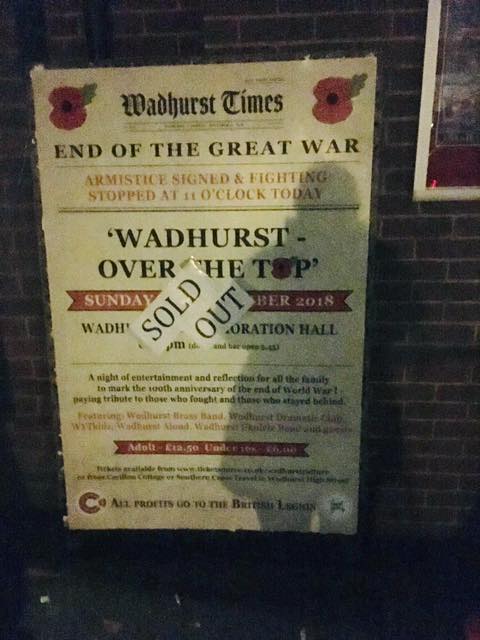
Wadhurst Over the Top, was a stirring concert that included members of both the Am Dram society and the children’s dramatics society. It included one of our local choirs “Wadhurst Aloud” and the Wadhurst Ukulele Group, as well as some singing acts. The concert started set in 1914 and ventured through the recruiting process, laughter behind the lines, loss and suffering and finally the victory and celebration. The bands two main contributions where to play “Aubers Ridge” which was a piece commissioned by the band – written by Stuart Fifield. It commemorates the battle of Aubers Ridge where most of our Wadhurst Men lost their lives. It was performed well and made a fitting tribute – but it wasn’t until the 2nd half where I experienced possibly the most poignant moment of my life in music to date.

2 hours later, the concert is approaching its grand finale. The war has ended and a young lad came in waving a news paper article simply reading “Peace at Last”. This was the point the Band finished the show with a hair-raising rendition of Elgar’s Pomp and Circumstance No. 4.

I had my fantastic band directly in front of me, the entire cast of the concert on the stage perched above the band, The choir where stretched half way down the hall on both sides of the hall. We had just about got through the tricky bit at the start. The balance was perfect. The band, breaching the edge of their endurance, skillfully neglected to show a single sign of fatigue. I cued the band to start the molto rit in the coda before the final reprise of the theme of “Land of hope and Glory.” Each quaver perfectly elongated against the previous, the band followed flawlessly. As I looked round to make sure all 80 participants of the concert where ready – suddenly, it hit me.

If it was not for that generation of heroes, The silent generation , I would never have had the opportunity to stand in front of all these people 100 years later and conduct this powerful and nationalistic music. Never before had I ever felt so indebted to anyone in my life. With the pride in my heart I thought “this is for all of you guys who made the ultimate sacrifice” I turned to the audience beating time for all to see and I sung like I had never sung before. Something happened in that moment, I looked around to see all the smiling faces, joyfully singing with the cast, the band, the choir and I. The pure emotion was bursting through my face and everyone was in it together. I reiterate, This is only possible because of the sacrifices that those millions of men, women and animals made.

On behalf of every generation that has lived since that horrific time. Thank you brave warriors. Thank you that we can continue to have moments of incredible fellowship and fortitude. This whole experience taught me the true power of music – because, a village (somewhat) divided by political views and torn between traditionalism and economical development – even if for a brief moment of time, became one idealism. We were all there to celebrate, morn, laugh and cry. It’s thanks to music (and, of course, drama) – that each of us experienced all of these emotions together. It was raw, authentic emotion! and that, to me, is the power of the creative arts.

Assignments, Part 3 - Assignment

Assignment 3 – Adventurous Counterpoint

Today (29/12/2018) I finished assignment 3. an exercise on counterpoint. I called this composition “Folk Law” It is called this because of its medieval folk feel. The composition is based on 3 triads. C# minor, E minor and A major. Each section of this piece is labelled with its own rehearsal mark.

I chose three flutes as I remembered when I first heard of   J.S. Bach’s “Brandenburg” concerto no. 4 (1.) how well two flutes sounds blended. They are also a good instrument for representing the medieval sound that I wanted for this particular exercise.

The start of the piece is written in C# minor. This was based on my previous task in counterpoint because I was enticingly  engaged in writing and producing this short piece of music. I wanted to expand upon what I had already written. The irregular time measures that I wrote contributed towards the medieval feel as did my choice of key signature. The first section is a nod to Jeremy Soule who is the composer of the soundtrack to “Elder Scrolls V: Skyrim” which is a medieval fantasy game. In that he wrote some of the folk-song’s performed by bards in the game in the minor key signature and punctuated his sentences as musical phrases. One of his pieces that stands out for me is “The Dragonborn Comes” (2.)

Section A modulates to E minor. I do this by using the Dominant B triad in second inversion. I chose to voice the chord this way because second inversion ins the least stable inversion and it meant that the intervals on the flute were easier to play. I used the scale in bar 20 to cement the tonal centre of E minor. As we enter the next section I re-introduce the rhythmic figure that we heard in bar 4 before the new rhythmic feature starts building up and accelerating from bar 26 to the 6/8 Rhythm at rehearsal mark B.

I used a dominant 7th chord to transition in to B. The VII (D) is in the top line so it stands out. This section represents a good old fashioned knees up represented by the two groupings of 3 in a 6/8 and alternation between a dotted quaver and three quaver rhythm. This is quite similar to the sort of Irish folk music that you hear. The section is based on the A major triad. A major is the sub-dominant of E minor but also the lower mediant of C# minor so as to keep the piece relevant to the original tonal centre. I use dynamics in this particular section to delegate roles to each part. The loudest dynamic would be the main melody. The Lesser dynamic would be adding harmony or a counter melody and the least dynamic provides a tonal centre for the bar to be built upon. A dramatic Ritard takes solemnly in to our next section (C).

In this section we have returned to the tonal centre of E minor and this is the slowest section of the whole composition. The Em triad I based this composition on is written in first inversion. I keep irregular time measures to maintain the context of the piece. In bar 75 I use a very similar suspension as Klaus Badelt and Hans Zimmer used in “One Last Shot” from the “Pirates of the Caribbean” soundtrack (3.) When we get to Bar 77 I  invert the rhythm played on the second flute in bar 76 which gives us an unsettled F natural. This statement says “get ready for a change” and then bar 78 uses the G# (dominant of C#) to augment back in to the original tonal centre of C# minor. We hear a slight reprise of the original melody for 8 bars. However the altered phrase in bar 87 changes the previous climax of the High C#s in bar 9 and places is in a much less triumphant feel only reaching the high B not quite the triumphant High C#s from before but we gradually morendo back to our very first triad of C# minor – complete in second inversion.

I thoroughly enjoyed bringing this piece to life. I challenged myself to use an array of time signatures specifically as it was a new challenge and I found that by doing so you can incorporate some really unique musical phrases. I tried to maintain strict polyphony but I notice that I have specifically used different chords in some places to punctuate phrases and particularly in section B where I have used one line as chordal accompaniment. However as the notes changed every bar. They could be used to perform longer phrases which if I were to us lyrics could be used as a significant contrasting melody line with some powerful lyrics. However I thoroughly enjoyed referencing a video game composer.

References:

1.) Brandenburg Concerto No. 4 in G major by J.S. Bach

2.) “The Dragonborn Comes” from “The Elder Scrolls V – Skyrim” by Jeremy Soule

3.) “One Last Shot” from “Pirates of the Carribean” by Hans Zimmer/Klaus Badelt


Part 3 - Project 10, Projects

Project 10 – A Contrapuntal Trial

Today I have written “Folk Law” which is a short piece of music scored for three flutes. The aim of the project was to write three independent melody lines which would work together to create a Polyphonic texture.

I thoroughly enjoyed this project. I wrote the piece in C# minor as it is a personal favourite key signature. As the time signature jumps between 4/4, 3/4 and 2/4 it has an interesting uneven feel to it. This meant that I could get some unique phrases within each instrumental line. I originally hand wrote the melody lines and played them on the piano. When I had the melodies and phrases I liked I could feel there would be a medieval feel. This is the reason that I chose three flutes as they match the sound. My next choice would have been recorders.

The Harmony is created by the overlapping of the melodies. I started my piece on the dominant triad of C# minor. We then venture through the chords of F# minor, E minor, D# Major and in bar 13 we have a G#sus9 which though unintended carried a nice dissonant sound to it, so I kept it in.

You will notice that the melodic lines move in contrary motion so that when the intervals in the top line ascend the Melody in the bottom line will descend and vice versa. The middle line will do one of either. Due to the nature of emphasising the the key signature C#, I kept my intervals small in relation to the tonic. This provided a basic level of intonation that appear frequently in that melancholic medieval style of music.

Part 3 - Project 9, Projects

Project 9 – Descants

For my next project I have written 3 Descant Lines for various melodies. I enjoyed writing the descants especially as we are coming in to the carolling season. One of my favourite Descants is O Come All ye Faithful. This has inspired one of my descants that I have written for project 9. One thing I found to be a challenge was getting too carried away with passing notes and realising that it put complete disregard to the harmony or it did not stay with in the particular chord that the bar was based around. So if there was a harmonic backing the notes would have sounded dissonant (and not nice dissonance either.) This became most evident in Kakki Se Kukku which sounds more like a theme with a variation being played over the top. The thing I found easiest was writing for the range of the instruments as I (in my bias) chose all brass instruments for this project.


The first melody is a 16th Century German Carol called “Quem Pastores” I wrote this for two trumpets because of the range of the hymn. I knew that with that range, I could write a clear descant which would project over the melody with power and still be in a moderately comfortable range for a good trumpet player. The descant begins within the triad of F major. Briefly visiting G major in Bar 4 and then reverting back in to F major. This reminds me that in an orchestral setting, I would have to be more aware of the chords that are harmonising underneath the melody. I would have to keep the descant within the chord unless it was a passing note. You will note, that, as is typical with the descant – the descant will move in pitch when the melody is mostly still and the Descant will move up if the melody is moving down or vice versa. This provides an effective contrast which helps both lines be heard. I accidentally re-wrote what sounds like a bit of John Williams’ Jurassic Park in bars 9 and 10 however, in my opinion, it helps to build to the bigger moving passage in bar 13 of the descant line. This is because as the player slurs and hits the same note (F) three times, it’s easy to show the dynamic increase in each of those F notes.


I chose Kakke Se Cukoo as my second melody. This is a Finnish folk song. I chose two Euphoniums because the euphonium has a phenomenal range  I found it quite difficult to write a descant for this because the melody itself moves near enough every beat. As the descant has to contrast to the melody I chose to use a lot of semi-quavers to move in the descant where you hear crotchets in the melody. As a result of the use of numerous semi quavers I have had to use scale runs to represent the ups and downs which counteract the melody and descant.


My third descant is written from the 17th Century Folk Song “You Gentlemen of England” I believe this was sung upon the British naval fleets war ships at the time. I chose this to be played by two tubas because it seems a fitting instrument for groups of rowdy sailors. The low register of a tuba is something to behold itself. The Melody moves regularly, similarly to Kakke se Kukku. Instead of using semi-quavers, however, I used minims and crotchets. As the pitch changes more frequently I could achieve more contrast from the melody then I could with Kakke se Kukku. The majority of the balance between descant and melody in this particular piece comes from the intonation and the pitch changes as opposed to the note values. This is the main difference between this piece and my previous two pieces.


Part 3 - Project 8, Projects

Project 8 – Composing Rounds

I have written 3 rounds for this project. Each round varies it’s harmony around one or two chords but contains different voicing of the chords. The Following videos are my Rounds and below them I will discuss each round and my reasons for what I have done:

In round 2 you hear a hymn written from the chords highlighted in example 36 (2.) in my university hand book. The harmony is basic at first just based on the C major triad. As more voices join the round the harmony becomes much thicker. The dynamics just outline the shape of the phrasing. This round is mostly consonant because the chords all form a pretty standard chord progression. Utilising only the 1st degree, fourth degree and fifth degree of the scale of C major.The only dissonance that occurs is briefly in passing in the melody. Bars 7, 8 and 9 are the most dissonant bars before they quickly resolve in to the triad of C major in bar 10.

In all of these rounds, I enjoyed the process of building the harmonies from just one line. It surprised me the rich variety of chordal voicing that can be achieved from just one line of music. Though I confess, particularly in Round 3, With the augmented G I struggled planning ahead with the harmonies. I would write a melody and then realise that when I go to layer the next line in with the existing line, the harmonies are completely out of balance. I addressed this by making changes in the melody as I wrote each phrase.


Round 3, on the other hand, is composed using the chords highlighted in Example 36 (4.) The tonal centre is D major and the university have introduced an augmented G (G#)  in to the progression. This makes for a very dissonant round. I specifically wrote the high line as high as possible to add to the haunting effect of the score. I enjoyed working with this progression as it was such a different sound.

My Final round includes work and is a song about drinking alone. I kept the harmonies simple when I though of the melody. The tune is simple so anyone could remember the words and sing along. I used the two chords outlined in example 36 (1.) from my university handbook. It briefly touches the C major triad as well (for example bar 5) Similar to round 2 – The only dissonance is passing in brief.