
Personal Development

11/11/2018 – A Weekend to Remember

Wadhurst OTT

It was 100 years ago when the guns fell silent on the western front. 100 years later a small community in the rural village in Sussex are one of hundreds of communities pulling together to remember this historical milestone.

My band – Wadhurst Brass Band had a phenomenally busy weekend. We had a concert on Saturday evening followed by a church service, a rehearsal and then another concert on Sunday evening. All performances rather individual to each other. One particular moment of the weekend highlighted the entire meaning of the sacrifice that whole generation of Men laid their lives down for.

On Saturday night we played two twenty minute sets. The choir did a 20 minute set in the middle of our sets. I chose to keep the first set serious and relevant. It included “Hymn to the Fallen”, “In Flanders Fields” written by Gavin Somerset and Elgar’s Pomp and Circumstance March No. 4. Our second set started with “Colonel Bogey”, followed by Karl Jenkins’ Lament from Stabat Mater. We finished our concert with a rousing performance of Peter Graham’s fifth movement from his “Cry of the Celts” – a very lively and meaty take on lord of the dance.

The acoustic of the church was immense. It’s as if it was made for a full 27 piece brass band. The band kept tight and true to the conductor and the performance clicked. Four notes call the piece to it’s end, before I had even turned around to the audience – two lovely ladies had risen to their feet, shortly followed by two more, then small pockets of people rose to their feet, and, before we knew it, the entire church was afoot with cheer and glee. The band had done it. Surely so, they deserved that standing ovation.

Then came Sunday. 100 years of celebration of armistice. We had a beautiful memorial service in the morning and it followed in the evening – when we participated in our biggest local project to date.

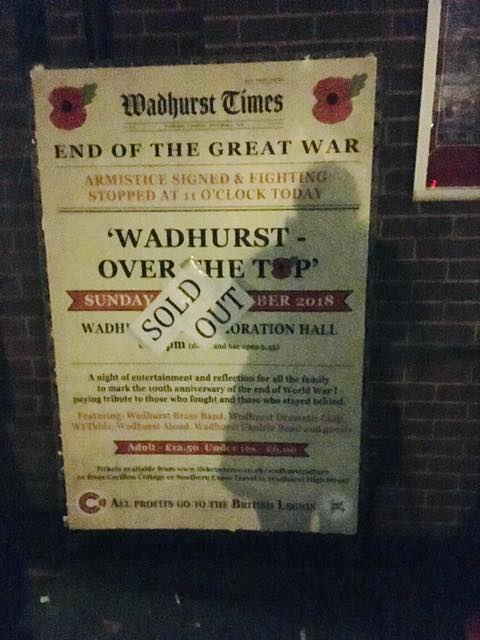
Wadhurst Over the Top, was a stirring concert that included members of both the Am Dram society and the children’s dramatics society. It included one of our local choirs “Wadhurst Aloud” and the Wadhurst Ukulele Group, as well as some singing acts. The concert started set in 1914 and ventured through the recruiting process, laughter behind the lines, loss and suffering and finally the victory and celebration. The bands two main contributions where to play “Aubers Ridge” which was a piece commissioned by the band – written by Stuart Fifield. It commemorates the battle of Aubers Ridge where most of our Wadhurst Men lost their lives. It was performed well and made a fitting tribute – but it wasn’t until the 2nd half where I experienced possibly the most poignant moment of my life in music to date.

2 hours later, the concert is approaching its grand finale. The war has ended and a young lad came in waving a news paper article simply reading “Peace at Last”. This was the point the Band finished the show with a hair-raising rendition of Elgar’s Pomp and Circumstance No. 4.

I had my fantastic band directly in front of me, the entire cast of the concert on the stage perched above the band, The choir where stretched half way down the hall on both sides of the hall. We had just about got through the tricky bit at the start. The balance was perfect. The band, breaching the edge of their endurance, skillfully neglected to show a single sign of fatigue. I cued the band to start the molto rit in the coda before the final reprise of the theme of “Land of hope and Glory.” Each quaver perfectly elongated against the previous, the band followed flawlessly. As I looked round to make sure all 80 participants of the concert where ready – suddenly, it hit me.

If it was not for that generation of heroes, The silent generation , I would never have had the opportunity to stand in front of all these people 100 years later and conduct this powerful and nationalistic music. Never before had I ever felt so indebted to anyone in my life. With the pride in my heart I thought “this is for all of you guys who made the ultimate sacrifice” I turned to the audience beating time for all to see and I sung like I had never sung before. Something happened in that moment, I looked around to see all the smiling faces, joyfully singing with the cast, the band, the choir and I. The pure emotion was bursting through my face and everyone was in it together. I reiterate, This is only possible because of the sacrifices that those millions of men, women and animals made.

On behalf of every generation that has lived since that horrific time. Thank you brave warriors. Thank you that we can continue to have moments of incredible fellowship and fortitude. This whole experience taught me the true power of music – because, a village (somewhat) divided by political views and torn between traditionalism and economical development – even if for a brief moment of time, became one idealism. We were all there to celebrate, morn, laugh and cry. It’s thanks to music (and, of course, drama) – that each of us experienced all of these emotions together. It was raw, authentic emotion! and that, to me, is the power of the creative arts.

Assignments, Part 2 - Assignment

Variations on a Waltz – Assignment 2

I wrote this piece as a clarinet solo because after two months of solo woodwind analysis, I concluded that the clarinet is, in my opinion, the most versatile instrument in the woodwind family.

In the composition, I instantly state the range I intended using throughout the composition in the 5 bar introduction.. In the same way Gordon Jacob stated the range of notes he was going to use in movement IV of his Seven Bagatelles. I stated the notes of the major scale that I was going to use the bar before A.

In section A, I show the main 24 bar theme which I variate twice. The theme itself is specifically within the comfortable register of the clarinet. The melody itself is meant to be enjoyable for both performer and audience alike. I include a characterful glissando at the end of the theme so that the performer can milk it for all its worth.

The Anacrusis of section B brings us in to the The first variation . I use the warmer lower register of the clarinet as we have transposed to B minor. This was a technique I learned from project 5. The idea of having semi-quavers in a slow passage came to me after listening to Alan Hovhaness’s Lament for clarinet solo. Part of the characteristic of the clarinet is the ability to play fast intervals and still maintain a mature level of expressiveness.

Section C focuses on the virtuosic properties of the clarinet. It has very fast passages, incorporating the use of demi-semi quavers and semi quavers. These passages are mostly written in the major scale while the accents outline the original theme. I adopted frequent use of the higher register as I aimed to keep a bright and spirited sound.

Where as I am pleased with my main theme and first variation, I struggle to enjoy variation II with such enthusiasm. I feel that there are too many fast bars and passages. I also worry that the intervals may be quite tricky and may sound a bit “muddy” when played live.

The composition follows an A, A(b), A(C) structure with a 5 bar intro where as the various changes in tempi are used to give the performers space to interpret as they like. It outlines the clarinets abilities to play both expressively in a cantabile style, as well as its ability to play virtuoso and strut its stuff.

Part 2 - Project 7, Projects

project 7

Today I wrote studies for clarinet and flute I used different scales so I could understand and learn about the intervals and characteristics of each scale. I wrote the flute study with the middle Eastern scale as I thought with the clear and pure sound of the flute it would be the perfect choice.

Flute Study

The Study is 24 bars long, 12 bars in the major and 12 in the minor. The study is written in a mix of 3/4 and 4/4 just to maintain interest. In doing this I learned exactly how this technique can help shape the melody line and phrases that I write. In bar 3 – I state all of the scale that I intend on using. This then lands solidly on the D as the tonal centre of the piece. Bars 6, 7, 8 and 9 bring a rhythmic contrast to the piece.

In the bars 12-24, I followed an idea from Gordon Jacobs Seven Bagatelles, I used the interval of a 4th but used the notes of the minor eighth note scale instead. The fact that I used a Bb instantly announces the presence of the minor key. I used triplets because I wanted relationship between bars 1-12 and 13-24th bars. Bar 19 is a direct rhythmic copy of bar 10. The study builds from 21 to climax on the tonal center D before ending on the sub-dominant fourth G.

The second study I wrote was the same format as my Middle Eastern Study – in that it is 24 bars 12 bars major and 12 bars in the minor. I had a lot of fun writing this! Having been in the pit orchestra for Fiddler on the Roof the obvious choice had to be clarinet!

To compliment the character of a clarinet I started the study with a gliss from the dominant to the tonic. The semi quaver triplets are a slight nod to the theme from poirot. I tried to incorporate the full range of the clarinet for the player. I slightly augmented the rhythm in bar 4 from the previous bar. We eventually morendo towards the end of the first half of the study.

The Second Half of the study is a complete rhythmic contrast to the first half. I could not resist the mathematical link in the first 2 bars of A and the 2nd two bars. While they are all noted of the minor Eastern European scale, Bars 3 and 4 of A are transposed down a third. Bar 5 starts the trend of the rest of the study as from bar 19 we descend down through the scale to the tonic of D.

Listening Log

Seven Bagatelles

I found the context of this musical work most fascinating! when this work was written (1971) Some composers believed that folowing the second world war, the only way to prevent another war from happening was to try and improve the academic intelligence of the nation! because of this musical culture was being driven towards modernism, experimental music and serialism by names such as Arnold Schoenberg, Igor Stravinsky and Anton Webern. I believe that Gordon Jacob’s aim was to look back upon some of the Neo-Classical music techniques and introduce some light-hearted music to deliberately try and avoid modernism.

Movement I – March

In the March I see a Motif straight away. This phrase ends on a Bb above the stave following (possibly) a diminished 5th (Gb), a minor third (Eb) and ending on a major 7th. (Bb) that’s assuming that we were in the Key of C major. However with the second motif response we have gone back to a solid B natural. The rhythm is then developed incorporating the use of of triplets and flattening the 4th. The flat 4th or diminished 4th is a recurring theme throughout the 7 bagatelles. At bar 7 we see a repeat of the original theme transposed down a semi tone. The phrase ends on a G# this would be a typical minor note if the scale was in the A minor harmonic scale. Following the G# in bar 13 we have the same rhythmic theme as before but where we were holding a solid B natural before we are holding a solid Eb, This is the minor third of C. The use of changing key signatures, combined with the ambiguity of they key signature and the variety of different intervals may have been tactics adopted to deliberately try and avoid the mathematical approach that was used in serialism.

Movement II – Elegy

To me the Elegy is developed of four main phrases which are stated in bars 1, 2, 3 and 4. In Bar 5 we have a slightly developed inversion of the first phrase where Jacob used semi quavers instead of quavers to get through the intervals. Typically there is a lot of ambiguity in deciding the key signature of the music. I can’t tell whether we are definitely in the tonic major key of Ab or in the dominant minor key (F minor) or are there any points where Jacob has used a transitory modulation where the played is actually in a key but only very briefly.

Movement III – Waltz

This movement has a very different feel to it. . We see the frequent use of intervals of a fourth that I have previously mentioned. There are various passing accidentals for instance the passing F# in bar 6 which are simply used as escaping notes. Where the key heads towards the tonal centre of G I would not say that it was in the Key of G major.

Movement IV – Slow Air

In the slow air we have a quaint and beautiful melody played Where the first bar wants me to say the key is definitely G major, the second bar, however, makes me want to say that the key is Ab major as if the key signature has been transposed up a semi-tone. This sort of Ab key sticks around until bar 4 where we have gone solidly back to the tonal centre of G. Before going in to the new key of E minor possibly for bar 5. It is because of the frequent use of both F# and Bb, Eb and Ab that it is hard to tell whether we are in the Key of G or the sub-dominant C minor.

Movement V – Limerick

As I analyse the limerick I cna see straight away that the 3rd bar is a mirror image of the 1st bar (after the anacrusis)the use of staccato with the groupings of 3 quavers brings a playful feel to this movement.

Movement VI – Chinese Tune

The Way Gordon Jacob achieved the oriental feel in this beautiful little bagatelle was by using the eighth note scales that are popular in eastern culture. If we treat this piece as if it were in A minor we see the re-occurring interval of a fourth in numerous occasions in the first four bars (A – D) we then here the end of the first phrase on an E (the minor dominant of A) In bar 7 we see all the notes of Gordon Jacobs chosen Scale until he punctuates the end of the phrase with a G, suggesting we might be in the relevant major (G is the Fifth degree or dominant of the key of C major). We then here the same theme decorated with escaping notes (Eschapé) – grace notes that do not agree with the chosen key signature. About 3 bars from the end we see them same rhythmic and melodic pattern where Jacob illustrates all the notes of the scale but with decorated escaping notes before he takes the phrase and repeats it up the octave to finish the piece on a top G – the dominant of C eighth scale minor.

Movement 7 – Gallop

To start we see the interval of a fourth followed by the interval of an octave before before the phrase is answered with again another interval of a fourth which goes down the major scale before going back up the octave in bar 4 (after the anacrusis)  before we are then taken to a minor third of Bb – the “blues notes” that I believe are a nod back to the neo-classical era.  This phrase is then repeated down a third in bar 6 and again in bar 7 but with the addition of an interval of a fourth in the second beat of the bar. The phrase ends on an F# – the leading note of G. The original phrase is then repeated and instead of using the same notes – in the second part of the phrase we have been transposed up a semi-tone in bars 8 and 9 and the responding part of the phrase has been transposed up a tone where technically we are in the key of A major. Until we revert back in to C major in bar 13 in bars 16-18 we see a definite tonal centre of E minor before repeating the initial pattern   from bars 5 and 6 – only this time they are in the key of E but with the major 3rd (G#) In bar 25 we have gone in to F major with a solid arpeggio of the F major chord in one bar and then the G7 arpeggio in the next bar then the arpeggio of A minor in the next bar. After this quick succession of chords we come back to our initial tune in bars 28 and 29 the tune is then repeated in an inverted state and we carry on travelling through the different chords relevant to the G major Scale. When we get to the key change we see a new variant in this movement. Jacob has gone to a dotted crotchet quaver rhythm. This helps to keep a lively feel but introduces some rhythmic contrast to the gallop. We then revert back to the original theme from the next key signature. This helped give the gallop a clearly defined A, B, A structure. The ending plants us firmly in the key of C major with the use of E natural (the major third) rising to the Tonic of C.

Listening Log

Danse De La Chavre

It is my belief that Honegger’s “Danse de la Chavre” is from an interesting era of music known as the neo-classical era. Some of the leading names of this era called themselves “Les Six” Who’s aim was to bring some more lighthearted music following the sombre  chamber music post World War One.

As I analyse the piece of music its obvious to me that in the music the key signature has been kept open as there is no real tonic or route note. The key is deliberately ambiguous as with the incorporation of an F# and regular use of E you could be forgiven for thinking that the key is E-Minor for the first 7 bars. The first 7 bars us the first phrase from which all the ideas are developed.

One of the key parts of the piece of music appears to me in bar 11 where there is a huge Bb, Now this could be either a flattened 7th of the C major or it could be a flattened 3rd in the dominant key of G major. Either way both possibilities point towards a “blue” note a degree of the scale that has been altered to sound more jazzy as was a common technique in the Neo-Classical era.

Within the bars 8-13 There is a chance for the flute to be as virtuosic as they fancy. The main dance theme comes in at the 9/8 bar. The ambiguity of the key signature still stands with frequent use of the previously mentioned Blues note of Bb. 6 bars in from the 9/8 bar the dance theme is played louder and developed by using more notes (using the semi-quavers) on the 12th bar of the 9/8 the theme has returned for a couple of bars with altered articulation (an accent on the C) still using that Bb blues note. WIihin bar 21 a new technique is used “rhythmic augmentation” where an extra bar has been added that punctuates between the phrases. In bar 27 of the 9/8 we see the same phrase but transposed down a tone. The new phrase carries the same augmented rhythm with the extra bar that incorporates a ritard to build to the final sound of the initial dance theme that starts 18 bars before the end. We are in a new key as the theme has now been transposed up a minor third, first starting on D on the 27th bar of the 9/8 transposed up to start on the F 18 bars before the end.

The last 4 bars revert back to the initial tune we heard at the very begging and ends on the only bar in which you can say that the key signature is definitely C major. That’s the last bar.