
Personal Development

International Brass Band Summer School

It feels like a life time ago now. On the week beginning the 30th July – I travelled straight up to Swansea on return from my band Tour in Brugges. I arrived half 1 in the morning ready for an 8 O’ clock start.

The course is ran by professor Nicholas Childs, Musical Director of the Black Dyke Mills Band. The tutors are from the top brass bands – a mixture of Cory and Black Dyke. I was under the expert tuition of Dr. Brett Baker who is the acclaimed best trombonist in the Brass Band world. Delegates come to Swansea from about 15 different countries all of them well distinguished in their trade. The composer in residence was Paul Lovett-Cooper, the man who’s composition “vitae aeturnum” inspired me to pick up my degree.

We are split in to two bands, Prestige and Sovereign. Brett decided that It would be a good idea for me to sit on first chair alongside my girlfriend, A decision he may well have regretted after the first day! However, sitting alongside Lauren meant that we could work very well as a section. Sure enough, it worked! As musicians we could read each other like books.

On the Wednesday we had a small entertainment contest, we are split in to 3 bands and deliver a 20 minute programme which is then adjudicated by two of the course tutors. My band the “Brighouse Blowers” played four pieces, the first of which was a Norwegian folk piece called “Pseudo Yoke” the second was an original composition of mine called “Funk Avenue” the third was “Baggy Trousers” and the fourth was a beautiful melody full of reflection. I just can’t remember the name! The band played well but we didn’t have time to perfect the programme as a result my piece sounded a bit messy but it was covered by the relentless beating of the percussion! I will try and upload a video score of funk avenue for you.

Thursday – rehearsals are in full swing for the Friday evening concert, I had a one to one lesson with Brett who helped me with my tone on the trombone. We also had a conducting session with the trombone sections of the combined bands. Where we would stand in front of a semi circle of 16 trombones, it felt like being put in front of the firing squad at dawn! But they are such a nice group of people from all backgrounds. We all head to Verdi’s ice cream and Italian Pizzaria in the afternoon before heading back to our evening site reading class.

Friday is the day of the concert so we have chance to Q and A with the tutors in the morning, however I had caught fire with a composition I started last year so I missed the Q and As to work on my Olympus suite. In the afternoon we had rehearsal for the big gig both bands were in fine voice and so after rehearsal we had some food and freshened up ready for the concert.

The concert went incredibly, my band performed works from Alan Fernie, Hans Zimmer and of course Paul Lovett-Cooper. We then left the stage for the other band to take the next half before all 120 delegates joined together for our massed band set which featured the liberty Bell, a Goff Richards arrangement of Crimond and a truly remarkable rendition of Tchaikovsky’s “March Slave” the concert was received well and there wasn’t a single face without a smile afterwards. After the concert is the party of the year, I don’t need to say the events that unfolded that night other then waking up with pink glittery hair, fully dressed sporting my finest pattern on pattern Hawaiian clothing in my girlfriends room who didn’t look best pleased!

It was a fantastic week in which I learned so much that I can take back to my own band in Wadhurst to teach them and hopefully further the bands cause. We have a busy schedule ahead Eastbourne Bandstand, a wedding, the start of the poppy appeal launch and then in November of course the 100 years anniversary of the ending of the vulgar “great war” hopefully, with what I learned in Swansea – we can give that poor generation of soldiers an anniversary fit for heros!
Personal Development

Martlets in Belgium

It’s been a while since my last post! Not through lack of effort I can assure you!

My band had been busy practicing and preparing their continental programme which consisted of a vast heterogenous of pieces from folk, soundtracks, jazz and blessings through to Celtic River dance + many more!

We started the Thursday at 07:00 where the coach departed from our practice room in Wadhurst. It was from there we would drive to Dover catch a ferry to Calais and continue through to beautiful Bruges. The sun was gleaming as it reflected off of the stunning but imposing architecture of Bruges’ industrial era. We had time for a quick Belgian beverage and a settle down before a very demanding but successful rehearsal in the hotel function room. This then left the evening free for the band to explore the area.

On the Friday morning the band ate its breakfast before continuing to explore this magnificent town. We had to meet at the coach for early afternoon. We all met at the coach and made our way to the coastal town of “Ostend” where we played in a Bandstand in a square surrounded by a variety of cafes and eateries. Even though half the band were a little “worse for wear” following the previous evenings endeavours we did not let this stop us giving our best. Even when the Mercury struck 34 C the band played on. We played our programme through – before one of our percussionists must have summoned the Lord of Thunder in the form of a very dramatic cymbal roll. There was a complete deluge! You could hazard a guess as to what piece it was. It was Pirates of the Carribbean, how delightfully apt!

The majority of our audience were passers by but there was one piece, our encore. Which captivated a few people to stop for a brief second in their busy lives to appreciate the hard work of the band. This is where I big that amazing group of musicians up:

The rain had stopped, the patio was bone dry in minutes. The band had played extremely well for an hour and a half. They were hot, bothered and probably had their chops falling off of their faces. However, this stunning piece of music “The Irish Blessing” boasts a stunning crescendo building over 12 bars from nothing to everything. And so the band grew, every beat increased the drama and tension and sincerity. The band kept giving and giving and then when I thought they had built up to their best, suddenly, the drastic sound of a tam tam pushed through and called the band to reach new heights I had never heard before from them.

Then the release. It was just two tenuto crochets to start the end of the phrase but articulated so delicately but brilliantly. The sound was rousing, chills shot up my spine as the band completely diminuendo into the silent beautiful last Blessing of the piece: “and until we meet again, may God hold you in the palm of his hand”

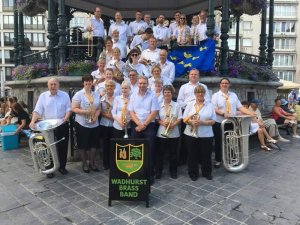
Wadhurst Brass Band fly the flag of Sussex from the Bandstand in Oostend Market Sq.

I hope to upload a video shortly so we can re-live that moment in every detail! The trip continued, we spent a few hours at the beach before all heading back to Bruges.

Our next concert was on Saturday. The coach left after breakfast for the town of Brussels. I’m not going to lie, I was nervous about this one, given the current political relationships of our two nations. What would they think of us? Would any audience even bother turning up for a British Brass Band? . It didn’t look promising at first, until we started playing. Slowly they filtered towards the bandstand, intrigued by what they were hearing. Before we knew it all the benches in front of the Bandstand where full. The programme was the same as the day before and the people of Belgium loved it. I even saw a group of young lads 17 or 18 years old who said they enjoyed the performance very much. The band then had some time to explore Brussels Grand Plaatz before all having a meal in the main square and heading back to Bruges.

Tours are so important for team cohesion, you all become a family and everyone gets a little bit closer – until we go back to our busy working lives. I fear that if music is removed from the curriculum. Experiences like this may fizzle out and become unattainable to future generations. Teamwork teaches skills like compassion, acceptance working with each others strengths and weaknesses. Banding is team work at its most fundamental level and is such a good way in to learning the skills needed. Please think about this when you hear about music being struck off music is good for the soul it can and may carry you through some of your hardest days as I know it has mine.

Assignments, Part 1 - Assignment

Wild Dance – Assignment 1

Today, I completed “Wild Dance” which is a composition for four untuned percussion instruments. In my case these are the following; Cymbals, Tambourine, Snare drum and a Bass drum.

My main focus was the structure of the piece of music. The structure of my composition can be segregated in to groupings of 12 bars. The structural map is as follows;

A section: 24 bars, B Section: 12 bars, C Section: 48 bars, B section (reprise): 24 bars, A section: 12 bars

I start out with the pre-written composition (as provided by the UCA Example 14) – this begins my “A” section. This is a 24 bar long section in which the second “grouping” of 12 bars does not stray too far from the first group of 12 bars. The ideas are only rhythmically developed by adding various extra beats in varied parts of the score. The most obvious build up is the additional use of the bass drum and the use of triplets in the snare and tambourine lines. This helps me to develop a different and unique feel for the music. The use of triplets at bar 20 can be used by the dancers on stage to add a bit of personality to the dance.

Section “B” is my shortest section at only 12 bars long. In Section B I mirror image or “retrograde” the whole grouping of the piece. I enjoyed taking a mathematical approach to the composition. I have taken the original grouping of;

  • 5, 3, 6, 5,
  • 3, 4, 3, 4
  • 6, 5, 3, 6

I replace it with its new grouping of ;

  • 6, 3, 5, 6
  • 4, 3, 4, 3
  • 5, 6, 3, 5

The rhythm mostly stays the same in the first 7 bars but then after the 4/8 bar I applied the retrogade to the original rhythm while keeping some of my previously mentioned rhythmic developments.

in complete contrast to both Sections A and B, Section “C” is the longest section of the piece it is 48 bars long and makes up the bulk of the dance. I have taken the initial groupings and re-arranged theme to compose a contrasting “quiet” section where the first 24 bars is led by the tambourine and the second 24 bars by the snare drum. The majority of the new rhythms are quite different from the old rhythm but they are still based on the beats that are emphasised in the initial idea. Before the main idea and instrument are featured at the stars of each of the 24 bar passages, there as a 6 bar introduction which calls between all of the instruments. the Bass drum and snare starts and the tambourine responds. The Cymbal adds decoration. In that sense, all four instruments seem to work as one conventional “drum kit” Before the leading instrument in then introduced. This technique could be used if there was, for example, more cast being brought on to the stage to join the dance. All detail is stripped away so that the audience can focus on the stage as the new cast join.

When we get to rehearsal mark “E” on my composition we stumble across a reprise of my “B” section. However it is 24 bars long so in effect you hear it twice. The difference is that while the first 12 bars are a complete retrograde of the initial idea the second 12 bars are only a retrograde of the original groupings. So instead of;

  • 6, 3, 5, 6
  • 4, 3, 4, 3,
  • 5, 6, 3, 5

we instead have;

  • 6, 5, 3, 6
  •  3, 4, 3, 4
  • 5, 3, 6, 5

its a subtle difference, but one designed to maintain the listeners interest.

At rehearsal mark “G” we have a recapitulation of my slightly developed “A”  section which drawers my composition to a close. The piece finishes on a gloomy beam from the bass drum as something drastic happens on stage and the demons cower and disperse in to the woods.

I thoroughly enjoyed this assignment and equally found it challenging enough that it required a lot of thought. As there is no melodious instruments, I decided that I would fall back on one of the things I love about music, the mathematical side. I was completely dumbfounded when I started this task. I had no Idea where to start. However, I remembered using mathematics in one of my previous tasks to build a rhythm up. This then tweaked me and reminded me that I can use the ability of pattern recognition and creativity to develop this example further.

Personal Development

The Banding Spirit

Yesterday, I participated in one of the greatest and most traditional of Banding events. The Whitsun Friday Marches. (the whits) I played euphonium with my Girlfriends Brass Band (Towcester Studio Band)

It is a most endearing festival which encourages Brass Bands of. All standards from all over the country, and sometimes, even Europe. During the whits – bands travel from village to village in the Manchester/Oldham area. From here, the bands will engage in a brief march from where they are taken to a nearby stage area. It is on the stage area where the band are adjudicated playing a March of the conductors choosing.

During Delph, one of the villages we visited, the heavens opened just as we formed up. In true Banding spirit the drums sounded and the band marched on. As the band marched on the rain never let off. It could have been a scene from an amazonian documentary. The spectators applauded and cheered and even the stewards expressed their enjoyment and support for this bands sheer dedication to their art and passion.

If that wasn’t enough to highlight what being a bandsman is all about, our coach broke down in Dobcross so the band decided this would not ruin their day out. So the drinks flowed and we stuck it out listening and supporting all the other bands as they marched and played. One band we saw consisted of a 25 strong contingent of no more than 12 year olds. Each of them playing the march without any music and by memory. The sound they made was beyond admirable! They departed their formation to the most ruptuous applause I have ever had the pleasure of witnessing at the whits. They were not the only group of youths to perform as we followed students of a county music service. All of who show so much promise for the next generation of banders.

During the course of our outing a drama occurred where one of the horn players had a domestic dispute which triggered a harmful psychological response. However, as being part of a band, I witnessed the true power of the comradery that stems from being a bandsman.

If I learned anything from my experience playing at the whits it is that there is such a fruitful abundance of life skills and experiences that can only be accessed through playing in a band of a tight cohesion. The ability to work as a team and pull through whatever is thrown at us, is such a reason that the financial abandonment of music services by the British Government is destined to create more harm than good.

Part 1 - Project 2, Projects

Project 2 – Duets

Today I wrote “Bongos and Congas” a study, you guessed it, for Bongos and Congas. I wrote this study in 7/4 because I wanted to push beyond my comfort zone. I went with the ethic that if I have a longer bar I can have much longer and more complex phrasing. The only other piece I know in 7/4 is John Miles’ “Music” but I guess that says more about my lack of awareness of most other experimental/contemporary music.

As the study begins the congas accompany the bongos. They are only used to highlight the pitch changes in the bongo line. However, I then turned this around on the 5th beat of bar 2. This is where the conga then repeats the phrase highlighted in the bongo line written in beat 4 of bar 2 note for note. As the congas reach the end of the phrase I reduce the rhythm in the 4th beat of bar 3 as the congas return to accompany the bongos.

As we get to beat 7 of bar 3, the conga has returned to lead the study. This is where the original rhythm is inverted and then slightly altered as I introduce more semiquavers in beats 1 and 2 of bar 4. The bongos then accompany the congas with the same inverted version of the original rhythm, in beats 4-7 of bar 3.

In bar 5, I further develop the original rhythm by incorporating the further use of semi-quaver triplets (as seen in beats 2 and 3 of bar 5.) The conga then repeats the new rhythmic phrase in beat 3 of bar 5. Both lines then conclude the phrase with the same cadence in both bars 5 and 6.

When we get to bar 6 beat 2 we are back to the original rhythm, played by the conga. Once we get to beat 3, the bongos carry on playing the further developed inversion of the original rhythm. In bar 8 the further developed rhythm on the bongo line has finished by beat 2. It waits for the conga to finish its rhythm before they both conclude the study in unison.