I am a studying composer of musical scores. I would like to write music for all types of orchestras and ensembles. "Where words fail, music speaks" - Hans Christian Andersen
In this section I have composed a short piece called “Who’s the Bossa?”. I wrote it for an ensemble of Latin percussion instruments. It takes the form of introduction, first section, second section, third section then there is a reprise of the first section. the reprise forms a four bar outro. In each section, I alter the position of the 3,2 or 2,3 rhythm performed on the Maracas and Claves. I then build the assisting or accompanying rhythm from the claves highlighting the rhythm played by the wooden instruments.
In section A, I introduce the Okonkolo and Bongos. This section is aimed at building up a sense of excitement in the piece. The okonkolo and Bongos build this section up with a typical call and response. It is not in it’s full Bossa Nova swing yet – as the emphasis is not highlighting the 2, 3 or 3, 2 rhythm played on the claves.
At section B the Okonkolo and Bongos carry on in call and response but they are now putting emphasis on the 2, 3 feel. The mechanisms I have used to emphasize the beats are articulated accents, intervals and rhythms. For instance in bar 20, I have used the higher line of the Okonkolo to highlight the clave rhythm. I have used semi-quavers to emphasise rhythm on beat 4 of bar 22.
In section C, the 3, 2 feel has been restored but has been placed one beat further forward. This then has a whole new syncopated feel. Both the Bongo and the Okonkolo lines are much more involved. I incorporated the use of retrograde in bar 33 to gain the new clave rhythm. This instrumentation and rhythm is being diminished back to the original rhythm at bar 38 as the original clave rhythm returns.
On Saturday the 9th November I got my band together to perform three of my original works. The concert finale was a suite in five movements that I wrote about an original take on the story of Hercules. Each movement is between 2-3 minutes long and the whole composition, once the narration between movements is added the whole piece should last 15 minutes.
Movement I is entitled “the Pilgrimage of Olympus” and represents Hercules as he ascends Mount Olympus following the summons of his Father Zeus. The piece starts with Hercules standing at the bottom of the mountain whilst he gathers his thoughts. As he begins his ascent the basses provide a driving rhythm that forms the basis of the movement. As Hercules climbs Mount Olympus he first hears a fanfare of trumpets practicing in the distance. The higher Hercules goes the more tension builds as represented by the intervals written later in the movement. As he gets closer to the top of the mountain the harmony becomes more dissonant and the low tom represents Hercules’ eager personality as nothing will deter him from fulfilling his destiny. As Hercules arrives at the top of Mount Olympus the whole band joins in in the fanfare welcoming Hercules home.
Wadhurst Brass Band perform “The Pilgrimage of Olympus” conducted by David Healy-Richards.
In Movement II we hear Aphrodite the night before battle serenading the gods to keep their morale as high as possible. Aphrodite starts the theme before the chorus erupts as all the other divines join in. However the jollity must be put aside as the Divines know what lies ahead. This is represented in the second half of the movement with the introduction of the timpani – representing the war drums of Olympus.
In Movement III – Hades’ plan is in full motion it starts in the underworld as represented by crunching dissonance and scurrying chromatic scales. Hades theme owes some of its inspiration to Chopin’s “Marche Funebre” utilising the same interval that Chopin used. Hades begins to tear in to the Morale of the Gods as he twists the morale and tries to get in the minds of the gods. This is represented by Aphrodite’s serenade written in the minor key. As Hades army builds strengths the texture of the movement becomes thicker before eventually building in to a march as the Army of Hades advances.
Wadhurst Brass Band perform “Hades and the Army of Lost Souls” conducted by David Healy-Richards.
Movement IV represents Alcmene, Hercules mortal Mother who sings the lullaby she used to sing to her baby Hercules. This is the moment in the piece that is aimed at hitting the listener straight in the feels! As she sings her lullaby she tries to convince herself that Hercules will be okay, this movement tries to capture the feeling of any mother who has had to go through the emotional turmoil of sending their sons and daughters off to fight. Alcmene almost convinced herself that everything will be okay, but, being a mother she can’t hide her worry anymore! The following video contains running commentary with Wadhurst Brass Band playing in the Background.
In the final movement both the forces of good and evil are at battle together In this movement all the motifs used in the previous movements are brought together to represent the battle twisting and turning between good and evil before the fanfare from the first movement and Aphrodite’s serenade rings through representing the victory of the Divines and you hear Hades driven back down to the underworld defeated by the devastating power of the Divines lead by Zeus.
From writing this concert item I learned so much about ways I need to develop myself as a composer and a musician. I thoroughly enjoyed the research involved with writing a long piece of music and each little movement telling it’s own story before each story joins together in the last movement in a huge clash of all of my musical ideas. However I have found a few areas which will need development;
Understanding range – All of my tenor horns notified me that the range was incredibly high for long amounts of time not giving the musician’s lip chance to settle. Where possible I may have to re delegate bars and phrases to other sections. Long phrases – while most phrases can be shared if there is more than one to a part it became apparent that the instruments that just have one to a stand would struggle with the passages I had written. Over concentrating on little details – This can be seen as both good and bad, I had a set idea of how I wanted the music to sound in my head and kept trying to bring it through from the band in doing this I got myself to bogged down on little intricacies and other areas of the piece may have suffered because of this. When I next do a workshop I will try to focus more on the overall picture than little bits.
However, I have also received a lot of positive feedback from the audience and the band saying that they liked the music an appreciated the challenge. In some cases I got told that they were happy with the areas that I decided to develop in this piece (intervals on the euph and section work) some people said the motif played in movement II was “beautiful” These are all useful pointers that I will take on board for my next workshop.
I would like to thank the Wadhurst Brass Band and our deps for all of their work on the day. I would like to thank Merlin Beedell who recorded the whole concert and took the photos throughout the day. I am proud of the Band and I am extremely grateful to the fantastically supportive audience who came along to listen even though it’s not the normal Band type programme. It was a fantastic day and one where I felt everyone took something from it. I look forward to more in the future!
On Saturday the 9th February I organised my band a workshop where we would have sectional rehearsals throughout the course of the day, followed by a full run through and then finishing the day – with a formal rehearsal open to the public in my local commemoration hall. The programme consisted of three of my own works. These were “Funk Avenue” “Moonchasers” and finishing with a concert suite of 5 movements called “the Olympus Suite.” This workshop was put together with the Wadhurst Brass band having no previous experience of the pieces. The idea of this workshop was to challenge the musicians in the band and stretch myself as a composer and conductor. This will form part of an on going series of workshops which I intend to broadcast and eventually put towards my degree.
In this blog I am going to focus on the first programme item of the evening “Funk Avenue.” The drum takes the introduction so that the musicians and audience can gain a feel for the piece and settle in to the rhythm of the track. This is then followed by a very simple bass riff consisting of both syncopated and un-syncopated rhythms based on the G minor pentatonic scale. For me, as a trombonist, this piece loaned itself to the occasional glissando as demonstrated by the first major 7th chord as played by the trombones and baritone section.
Funk Avenue discussed by David Healy-Richards and performed by Wadhurst Brass Band
Score Video – Funk Avenue
The piece follows a strict rondo form consisting of 3 sections (A,B and C) with a musical break (D) played to punctuate between the different sections. Together, hese sections form the ADBDC rondo structure. The first section starts at letter A and is played until letter B. At rehearsal mark B we see our first “D section”. In this section I introduce a riff on solo cornet and flugel that will be used to glue the two different motifs together. This is the form of a break consisting of “call and response” technique between band and percussion. I mentioned this in the introduction. The next section (B section) is announced by the new “swamp funk” rhythm played on the kit at rehearsal mark “C”. With this section also comes a new motif played as a solo cornet line with the new drumkit rhythm. We hear a quick reprise of the “D” section 4 bars before rehearsal mark D. This reprise is diminished in length and the break is altered by the riffs being played by Repiano cornet and then Flugel. The rest of section D is a recapitulation back to the original motif until rehearsal mark E where we have the 2nd motif played over the first drumkit rhythm At Rehearsal Mark E. The first melodic phrase is introduced at rehearsal A as a euphonium solo. The rhythmic figure played in the background on the cornets at rehearsal mark A is a common feature performed throughout the piece. The drum kit in this section is holding a steady basic funk beat.
The harmony in itself is quite simple mostly a V, IV, I progression with the majority of the piece based on the tonic G minor pentatonic scale. I occasionally add a major VII for a jazzy feel. All melodic phrases are based on the tonic. I use musical stabs (e.g. Horns and Baritones at bar 46) to highlight the changes in the phrase. In bar 39 I discovered as I wrote that a simple Minor III, II, I progression created a brilliant break accompanied by a break on the drum kit.
Through studying M1 – composing music with UCA I am learning a much more intricate understanding of rhythm. I was able to apply this when composing the motifs for this piece of music and my more developed understanding of rhythm really comes to the fore in the percussion parts. In Particular, the relationship between the drum kit and the bongos. I would highlight the 2 and the 4 of the bar by using the higher pitched bongo alongside the snare drum which weaved so well to create a very satisfying emphasis on the strong beats of this piece of music. In doing this it helped the rhythm to keep driving on.
As I did not want this composition to be a case study on structure I added a few little quirky touches, the trombones ascending glissandos the use of the bongos, triangle, claves, hand claps and other various percussion just so that the band could have fun while playing this piece. I added various musical “stabs” throughout the piece and altered them just to keep the piece fresh. Using these varying rhythmic patterns meant that I could emphasize different parts of my melodic phrases. I try to create an illusion that within each melodic phrase there is always something different that we can hear each time. One of the devices I utilised was rhythmic displacement of the riff that I introduced I the first “D section” as it is played throughout the piece at different places in the bar again maintaining interest and emphasizing a different perspective of the same melodies.
I uncovered a few areas of improvement within myself as a composer throughout the course of the day. My players had informed me of mis-leading muting instructions and lack of varying dynamics. These are all constructive criticisms and I know that to progress as a composer – I will just need to pay more attention and take more care when instructing mute or dynamics. As a conductor I learned that I can get too bogged down on certain aspects when I host a rehearsal. In order to develop as a conductor I will aim at first trying to get the band to play the overall piece as accurate as I can and then iron out any small wrinkles once a band is more familiar with my compositions.
I would like to thank the Wadhurst Brass Band and all the participants of the day and the audience for all of their support throughout the day. I would like to express my congratulations to a community band for doing such a good job of playing some really tricky bits of music in such a short amount of time.
Yesterday I completed project 11 where my task was to first compose a contrapuntal counter melody for the examples given on the OCA student handbook. (1.)
I used the principle of contrary motion for this example. This meant that where the first melody was moving – the second melody would remain steady and vice versa for the whole first phrase and half the second phrase. the counter melody was strictly mathematical. I used the sub-divisions of each beat to write the counter melody. For example, the dotted crotchet at the start of the melody line housed 3 quavers (as performed in the second melody line.) As a general rule anytime the melody rise in pitch, the counter melody would drop. The articulation between the two is also slightly different. I employed the use of phrase marks regularly in the first line to make the piece very legato and smooth, where as, in contrast the second line varies between staccato and tenuto.
In Example B, I took another strict mathematical approach but in a different way. As you will observe the intervals directly correlate to each other but heading in the opposite direction. I started the Inversion on B and it has produced some very dissonant clashes. Unlike my first countermelody that was mostly consonant. One of my favourite cases of inversion was the romantic composer Sergei Rachmaninoff in his “Rhapsody on a Theme by Paganini” where he inverts the melody, places it in the major key and transposes it to Db Major and slows it down. (2) as you will see in exampe 47 B, I have used directly contrasting articulation which gives the inverted counter melody a whole new character of it’s own. While I would say I enjoyed using a mathematical approach I must confess, in this particular exercise I don’t like what I hear!
I then went on with the project and wrote two melodies. One is a hymn with a variable time meter. This allowed for interesting and unique phrases. The other is quite a lively piece with the instruction of “FrÖlich” (cheerful, joyful) (3)
A Contrapuntal Hymn
The video above, is the hymn tune and changes it’s time meter frequently the idea for doing this came to me from listening to Blachers Piano concerto No. 2 in variable meter. In bar 2 I augment the first bar by a beat and in bar 3 i introduce my next technique of contrasting motion. This forms the basis of the counter melody it is mostly written in contrasting motion that, almost like a descant. I chose a xylophone and clarinet because a xylophone is quite low in pitch with a mellow wooden sound. I kept the clarinet in that register so that both melodies blend. Whilst I instructed “Maestoso” or “majestically” which to me indicates detached and pronounced individual notes – I kept the xylophone legato and smooth so there is a subtle contrast in articulation.
Upside Down, Inside Out
Above is the next video of project 11. I called it Upside Down, Inside Out as a relevant indicator to the composition mechanisms I used to devise the counter melody. The first three bars are the same melody but performed a bar later. This is a technique knows as “imitation” the last 6 bars of the counter melody are in retrograde. I mirrored the melody line from bar 5. One of the challenges I enjoyed about this technique is making sure that when I was in retrograde, the piece will remain as consonant as possible. Most of the longer note values work in with the main melody line. They are related in a harmonious chord. I was particularly happy with this composition project as I got to utilise a variety of different techniques including rhythmic augmentation, retrograde, inversion and contrary motion
If I were to evaluate my compositions I would try to expand on different composition techniques that I have not used. I would utilise the technique of rhythmic augmentation more, because though I touched the surface I still think I have more to learn about this particular mechanism.
So the Christmas dust has settled and everybody’s shared their “New year, New me” sentiments. We have all quickly sunk back in to reality. As I was reading through some of my friends New Years resolutions I thought perhaps I could make one, and so I set about doing just that. It directly affects my university studies and my journey to becoming a published composer. I am 6 years in to my current job and not a day goes by where I am able to convince myself of a positive “can do” attitude at my current job. Not that I let it affect my work performance. I lost that ability well over four years ago. I am in a position to put proceedings in to place in order to progress towards my real passion: Music.
The Journey of 1000 Miles, begins with one step
Lao Tzu
As for my ambitions this year. My indefatigable advance towards being a composer is in its first baby steps. I have devised the first of, what I intend to be, a series of workshops. I am both extremely excited but slightly apprehensive about this workshop. It is the first time I have done anything like this. However I am in great company thanks to the musicians of Wadhurst Brass Band. In these workshops my band will be rehearsing my own scores. A good friend of mine and of the bands, Merlin Beedell, will be recording the concert at the end of the day. The recording will then be sent to every Brass Band publisher that I am aware of. As of yet all I can do is ask the publishers opinions and HOPE that they will give me some productive feedback. I do not anticipate publishing as these are only my very first compositions. That does not mean I am not proud of them.
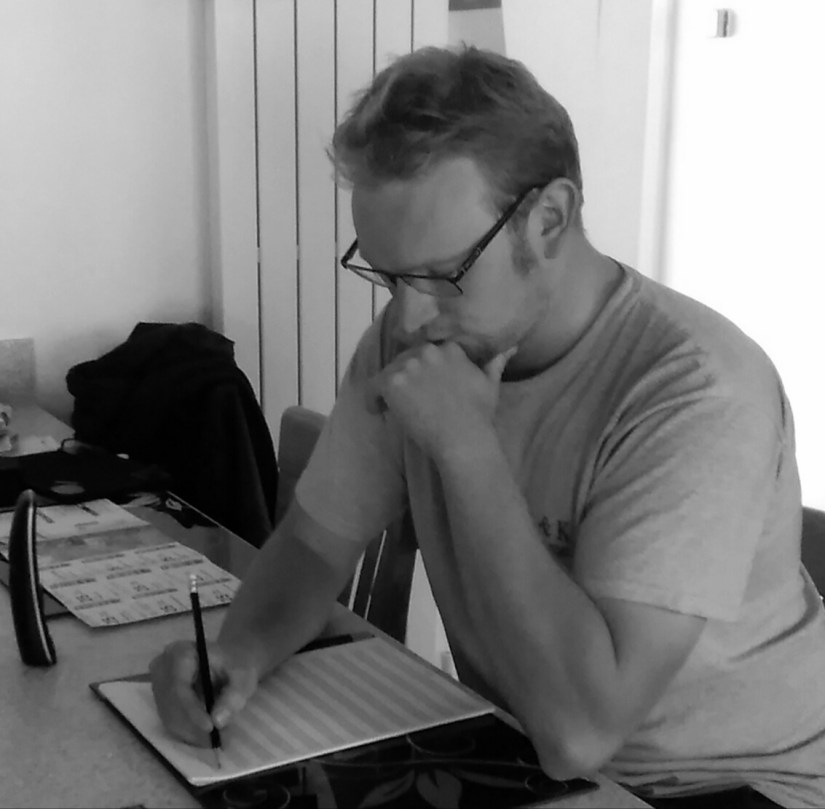
Drawing up a composition map for “The Olympus Suite”
This years Music programme is as follows:
Funk Avenue,
Moon Chasers
The Olympus Suite
The first workshop is taking place on Saturday 9th February 2019. The workshop starts hopefully at 11am and will run through to 8pm. There will be sectionals until 5:30pm where there will be a full rehearsal. The rehearsal will last until 6:30pm where there will then be half an hour for a quick pint. The performance will commence at 7pm.


 David Healy-Richards Music